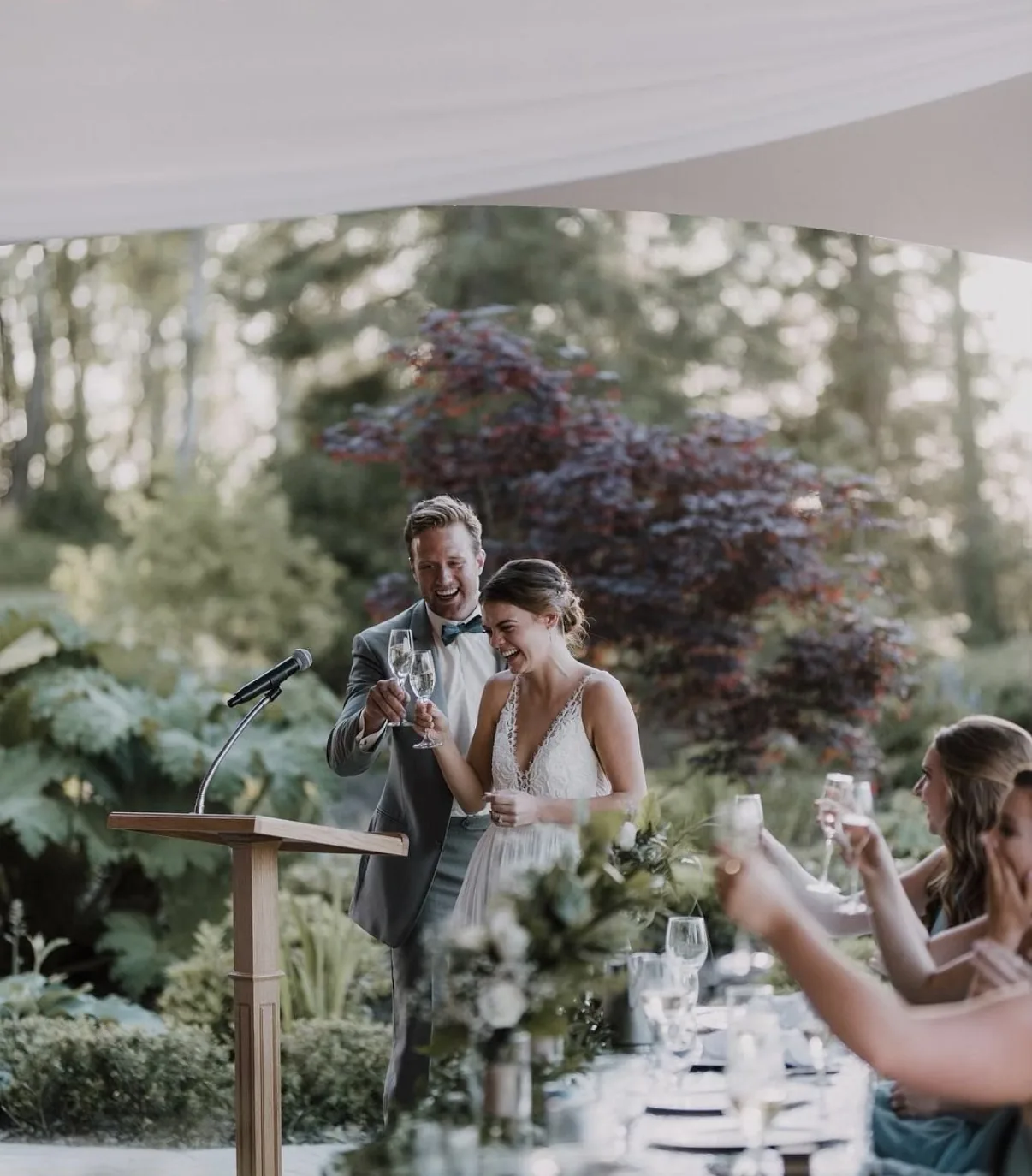
The day
Best man and maid of honour speech: structure, templates, what to avoid
A good speech doesn’t need you to be funny or to have a big voice. It needs a true story, a simple structure and the sense to stop in time.
Key takeaways
3 to 5 minthat is 400 to 650 words at an unhurried pace. Beyond that the room drifts, even if it’s good.
- A best man or maid of honour speech works best at three to five minutes: 400 to 650 words at an unhurried pace of about 130 words a minute.
- The structure that works has five parts: an opening line, who you are to the couple, one true story, what you’ve understood about them, and a toast.
- One anecdote told in detail beats five summarised. It should make the couple smile before anyone else.
- Two negative rules: no exes, and nothing the whole room doesn’t know about. The rest is taste.
In this guide
You’ve been chosen, and part of the job is speaking in front of a hundred people. The good news: nobody expects an orator. The room is on your side, there for the couple, and ready to laugh and get emotional at the slightest cue.
The five-part structure
- The opening (20 seconds)One sentence that gets the room: an observation, a number, a small provocation. “I’ve known James for eleven years, and this is the first time he’s been on time.” It sets the tone, and it gives you time to breathe.
- Who you are to them (30 seconds)The room may not know you. Say who you are, how you met each of them, and how long ago. Two sentences are enough.
- The story (2 minutes)One story, true and precise: a trip, an evening, a moment when you saw one of them change. The detail is what makes people laugh or well up: the colour of the car, the exact words, what you ate.
- What you’ve understood about them (1 minute)What makes these two fit together. Not a list of qualities, an observation: “Emily makes a plan for everything, and James always finds a solution when the plan fails.”
- The toast (20 seconds)One wish, in a single sentence, then “To Emily and James!” and you raise your glass. Don’t end on “so, yeah”: the last sentence is the one people remember.
Three templates to adapt
The one that raises a smile
“Good evening everyone. I’m Charlotte, Emily’s oldest friend, and I was asked to keep it short, so I’ll start with the most important thing: Emily, you look wonderful. James, you don’t deserve her. More seriously, I met Emily at school, aged eleven, when she lent me a pen she then asked for back for six years. James, if she lends you anything, you know what you have to do. But what I’ve understood about Emily is that she always gives back more than she borrows. She has given James, in a few years, what most people spend a lifetime looking for: someone for whom you are the most important thing. To Emily and James!”
The moving one
“Emily, James. I’ve been watching you since this morning and thinking of a winter evening six years ago. Emily rang me at midnight to say: ‘I think I’ve met someone.’ She didn’t say who, she didn’t say anything else, and yet I knew. That night I understood you can hear a person change from their voice. James, you made Emily lighter. Emily, you made James braver. I have nothing lovelier to wish you than to stay the ones who do that to each other. To you both!”
The two-voice one
The first speaker tells how they met the bride in a minute and a half; the second tells how they met the groom in a minute and a half; then they finish together: “What we have in common is that we know them well, and we’ve never seen them this happy. To Emily and James!” Simple, symmetrical, and each of you speaks about what you know.
What not to say
- Exes, old flames, “former lives”: it isn’t funny to anyone, even those who knew them
- A joke only five people understand: if the room needs the context to laugh, don’t tell it
- Comparisons with other couples, and remarks about looks or weight
- Unsolicited marriage advice: you haven’t been married longer than they’ve been together
- An anecdote that embarrasses one of them in front of their family, colleagues or grandparents
On the day
- Time yourself standing, out loud, at least twice
- Print the speech in large type, or write keywords on a card: a phone can go dark
- Have a drink, not several: one for the shaking hands, not three
- Look at the couple at the start, and the rest of the room at the end
- Tell whoever is hosting or the DJ when you’re on: they’ll cut the music and hand you the microphone
Founder of Weddtap · author of our guides
We write from real weddings and public sources, listed at the bottom of every guide. No guide is sponsored and no link is an affiliate link.
Our editorial policyFrequently asked questions
Frequently asked questions
How long should a best man speech be?
When in the meal should the speech happen?
Can two people give a speech together?
How do you avoid crying during your speech?
Should you learn it by heart?
Another question? The team reads everything and replies in person. Write to us